The product
Every part can be replaced on site.
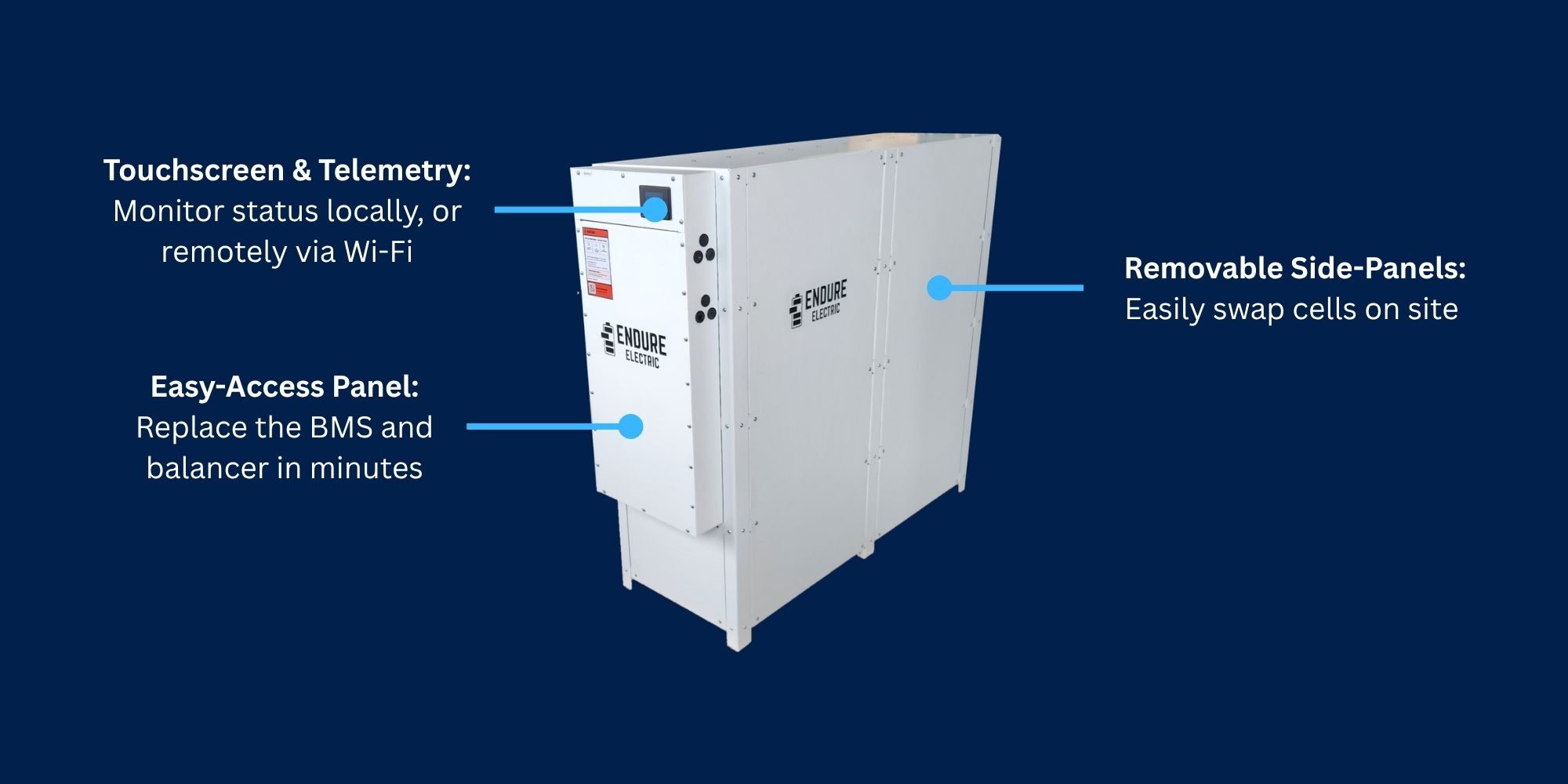
- Touchscreen and telemetry
- Monitor status locally, or remotely via Wi-Fi.
- Easy-access panel
- Replace the BMS and balancer in minutes.
- Removable side panels
- Swap cells easily on site.
Field-serviceable energy storage
Endure is a lithium iron phosphate battery for remote mini-grids in Africa. When a cell weakens, a local technician replaces that one cell on site and the battery keeps working.
The problem
Mass-produced battery packs are welded shut. One weak cell can take the whole pack out of service.
On a remote site, shipping a heavy pack away for repair takes weeks and can cost more than the pack is worth. Packs get scrapped early, good cells and all.
The cost is the repair trip: technicians travel out to the site, the battery is carried back, cleared across a border and shipped to its country of origin for repair.
How it works
Every cell is monitored over the site's Wi-Fi, so the cell that needs attention is identified remotely.
A local technician opens the enclosure and replaces that one cell. The battery works at 51.2 V, so the job needs no high-voltage specialist.
The rest of the battery stays in service. Every part, from a single cell to the electronics, can be replaced on site, so its working life keeps being extended.
The product
For battery owners
A local technician fixes a cell fault in minutes, so the battery never leaves the site.
Detailed maintenance instructions and remote support from Endure let local teams service the battery themselves, with basic tools.
Endure works with a broad range of lithium iron phosphate cells, so replacements can be sourced regionally.
Replacing cells as they age extends the life of the whole battery.
For funders
Factory battery production is built for volume and the lowest upfront price, and gives up the right to repair to get there. Across much of Africa, sites are remote and transport is expensive, so a battery that cannot be serviced on site is shipped away or written off early. Endure builds batteries that local teams maintain where they stand. Each battery comes with remote support from Endure and detailed maintenance instructions, so everything from a single cell to the electronics can be replaced on site. The battery's life is extended the way good asset management extends the life of a road or a bridge.
Second-life cells come from many sources and rarely match. Endure is designed to make mismatched cells work reliably together, so cells with useful life left keep earning instead of entering the waste stream.
Endure combines proven off-the-shelf components with its own remote monitoring and battery control, developed in-house to run mismatched second-life cells reliably in the field.
Second life is being tackled in ways that sound impressive but carry real limits on a remote mini-grid.
Custom circuit boards on each cell of a high-voltage string can bypass a weak or empty cell and keep the string running. The engineering is impressive. The boards are built for particular cell types, so cells from mixed sources cannot be combined, and a high-voltage system this complex needs specialist support on hand. It suits a factory with engineers on site.
Each pack of around 16 cells, about 50 V, gets its own inverter, so a failed pack drops out without stopping the system. That is far safer than one long high-voltage string. The cells inside each pack are welded together, so one failed cell still means scrapping the pack or shipping it to a factory with laser-welding equipment.
Endure started from first principles and the conditions on an African mini-grid: thin engineering support on site, long transport routes and cells from varying sources. The battery runs at a touch-safe 51.2 V, a local technician replaces cells one at a time with hand tools, and the control system runs mismatched cells reliably.
Who we are
Endure Electric designs and builds field-serviceable energy storage for the mini-grid industry. Based in Johannesburg, we design for the conditions our batteries work in: remote sites, limited access to specialist technicians, and long supply chains.
Get in touch
Thank you. Your message has been sent and we will reply by email.
Sorry, your message did not send. Please try again later.
Johannesburg, South Africa